

A 3D game engine you write in Dart
Game logic and interface in Flutter. An archetype entity-component core in C++. Google’s Filament does the rendering. The viewport is a widget, so the menu over it is an ordinary Column.




Website · Docs · Install · Gallery · Examples · Showcases · Discord
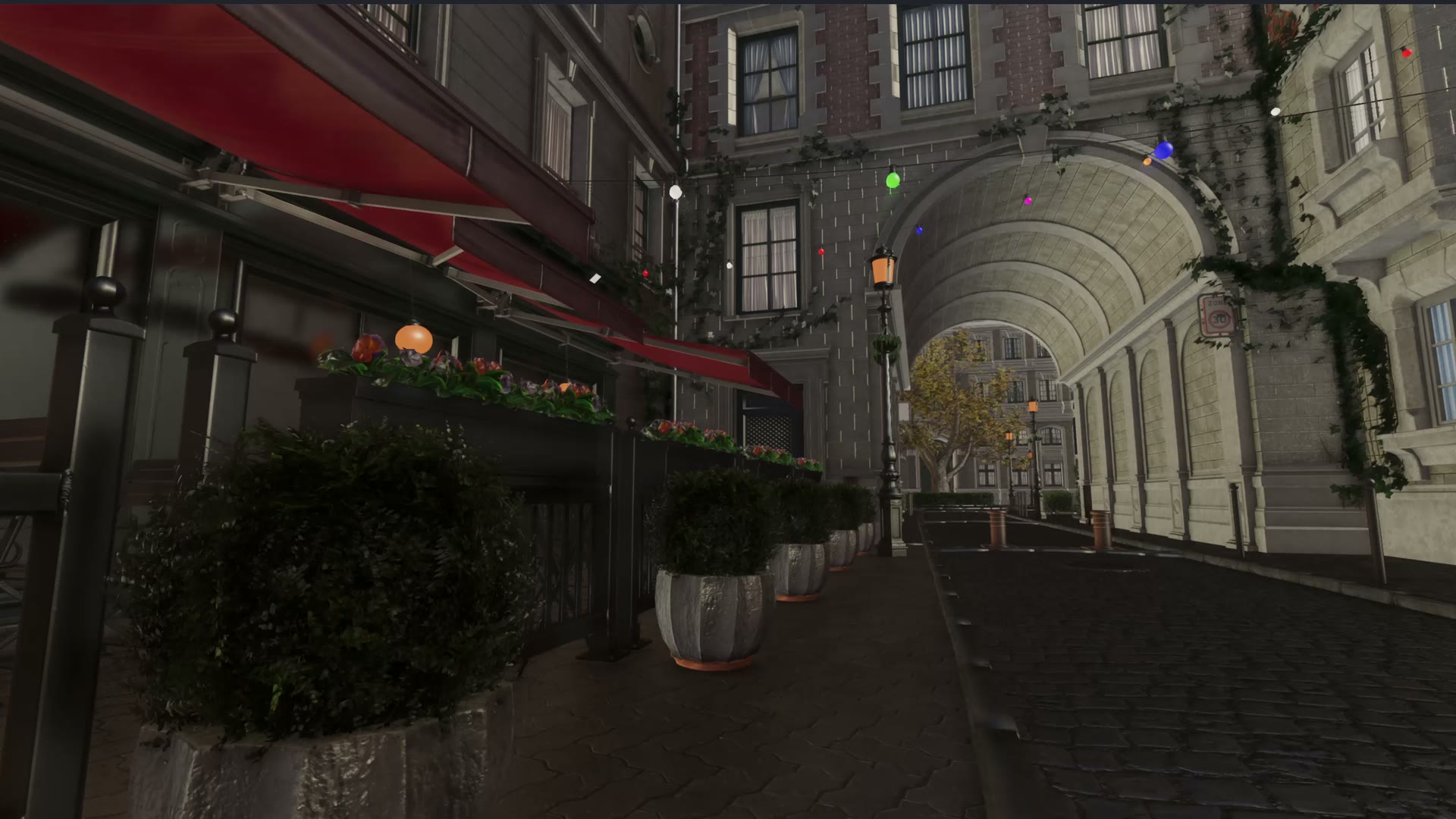
- Rendering. Filament's physically based materials, and a tone mapper that behaves like a camera. Image-based lighting from HDR or EXR. Directional, point and spot lights, cascaded shadows, and irradiance fields for bounced light sampled through a volume. A post stack with bloom, volumetric light, motion blur, occlusion, decals and selection outlines. Gaussian splats, instancing and populations.
- Simulation. An archetype entity-component store written in C++ behind a C ABI, with a transform hierarchy. Component data reaches Dart as a view over the store's own memory rather than a copy, so reading a column costs nothing to translate, and writing to one writes to the store.
- The scene is a widget.
OrblitViewsits in the same widget tree as everything else, takes part in the same layout, and is drawn by the same compositor. On Apple platforms the renderer draws into an IOSurface-backed buffer that Flutter takes as it is: no readback, no copy through the CPU. A panel can overlap the viewport, and the inventory screen has a widget test. - Games. Steering behaviours and behaviour trees. Armatures with poses and bone constraints. Camera shots that say what to frame, and blend between them. Collision. Sampled time, so the frame rate does not change the simulation. Multiplayer that replicates component columns. And TypeScript scripting on QuickJS, as a peer of Dart over the same core.
- 2D. Sprites in layers, atlas packing, parallax and tile maps, in the same scene as the 3D.
- Tooling. A desktop editor. A gallery app that shows every technique one at a time, beside the lines that do it. A build-time asset pipeline that cooks KTX2 texture sets per device. And a Claude Code skill, so an assistant writes real API instead of guessing.
- Formats. glTF, with FBX and OBJ converted on the way in. An
.oscenescene document with migrations and diffs. KTX2 compressed textures, HDR and EXR environments, and.ply,.spzand.osplatsplat captures. - Platforms. macOS, iOS, Android and the web draw today. Linux draws, though not yet on a real GPU. Windows builds on every change, and nothing has drawn on it yet. Platform support is fussy about that difference on purpose.
Every one of these is a page in the gallery app, running on a real machine. The showcases page carries the lines that do it, lifted from each example's own source.
| Showcase | What it is |
|---|---|
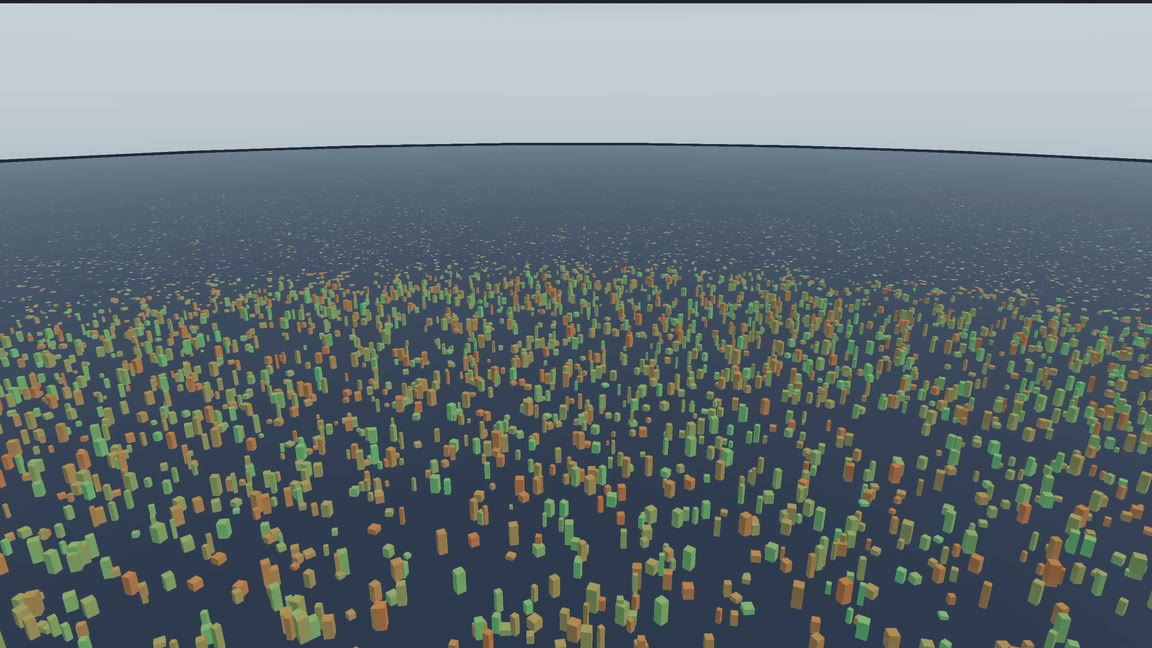
| Blocks | A landscape of sixty thousand cubes you can walk around and dig into, generated and sent once. |
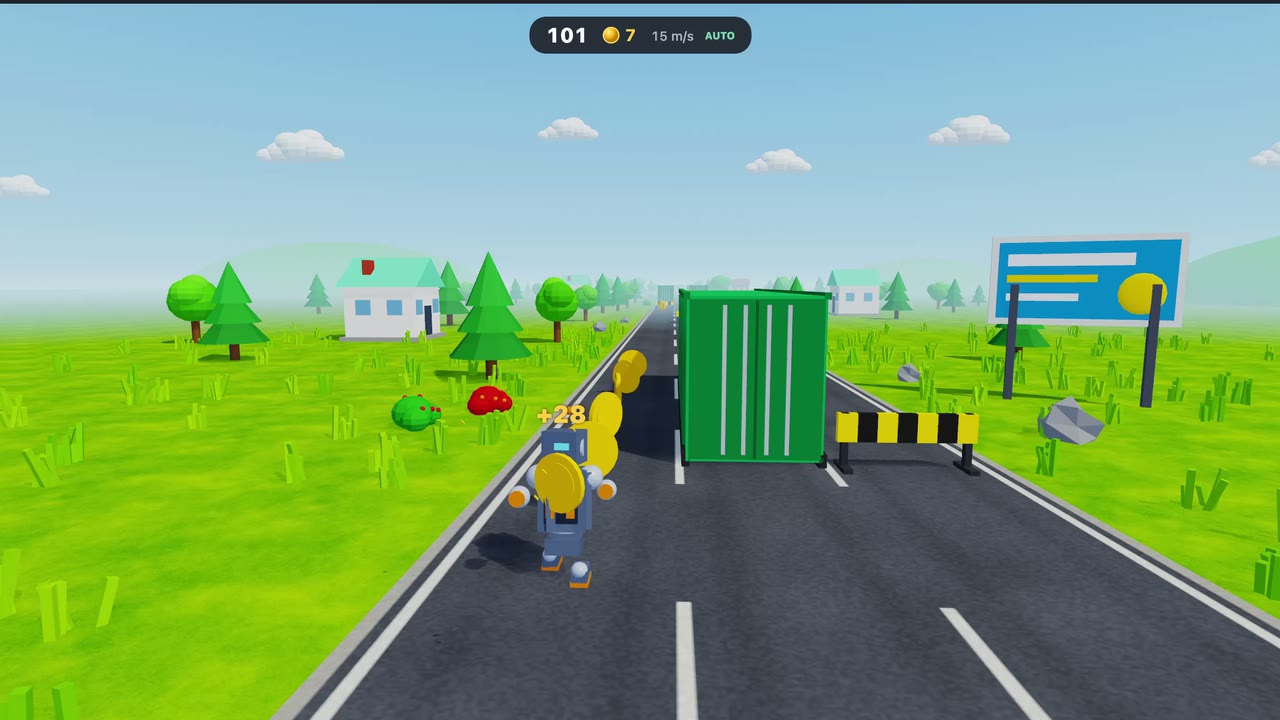
| Runner | A runner you can play: dodge, jump, slide and pick up coins. An autopilot plays it well enough to show the game is fair. |
| Bistro exterior | Somebody else's street, lit by this engine. A hundred lights at night. |
| Bistro interior | The room, and the one place where missing bounced light shows. |
To open the gallery on one:
ORBLIT_EXAMPLE='runner' flutter run -d macosRunning the examples covers getting there from a clean checkout.
The packages are not on pub.dev yet, so they resolve from git:
dependencies:
  flutter:
    sdk: flutter

  # Vectors and matrices. Orblit takes and returns these types rather than
  # defining its own, so it is a direct dependency of yours too.
  vector_math: ^2.1.4

  orblit_filament:
    git:
      url: https://github.com/ChxisB/orblit.git
      path: packages/orblit_filament
The renderer's native side needs one setup step per platform. It downloads Google's Filament SDK and compiles the materials. Installing has what each machine needs, and which machine can build for what. Your first scene is the shortest path to a frame.
./tool/check.sh # analyze and test everything that needs no window| Package | What it is |
|---|---|
orblit_core |
Archetype entity-component store in C++ behind a C ABI, with a transform hierarchy. Component data reaches Dart as views, not copies. |
orblit_codegen |
Turns annotated component classes into registration code, and a manifest other front ends can read without compiling this package. |
orblit_filament |
Filament rendering composited by Flutter's texture registry. |
Those are the three the rest is built on. The other nineteen cover geometry, rigging, animation, agents, cameras, lighting, sprites, scene files, UI and weather. They are all listed in the package reference.
| Repository | What it is |
|---|---|
orblit-net |
Multiplayer. Replicates component columns, with ownership rules and interpolation. |
orblit-script |
TypeScript scripting on QuickJS, as a peer of Dart over the same core. |
orblit-examples |
Worked examples of what the engine does, and how. |
Design notes live outside these repositories, as Claude artifacts, so a checkout carries what it needs to build and run, and nothing else.
Pre-alpha. Nothing here is stable.
The documentation at orblitengine.com is also
served as Markdown for language models, starting from
llms.txt. For Claude Code, this
repository is a plugin marketplace holding one skill,
skills/orblit. It carries the engine's model and its traps,
and makes the assistant check names against the source before it writes them.
In Claude Code:
/plugin marketplace add ChxisB/orblit
/plugin install orblit@orblit
Working with AI assistants has the rest.
It is early enough that the first thing you try is probably something nobody has tried yet. Either way, we learn something. The Discord is where that conversation happens, and CONTRIBUTING has what to run before a pull request.
MPL-2.0, © 2026 Chris Beckett. That is the Mozilla Public License, and it is open source. Fork it, change it, and ship games made with it, including commercial ones: your game is your own, and the licence does not reach into it. What it asks is that changes to Orblit's own files ship under the same licence, with source available to whoever you hand the result to, so engine work stays in the open.
Builds link Filament, which carries its own Apache 2.0 licence, and a prebuilt Filament.xcframework is committed here, so a full copy of that licence travels with it. See LICENSE and NOTICE.