To preview documentation changes locally, first install dependencies and then start the development server:
npm i
npm run dev
To sync translations after editing English docs, see Automated translation below (npm run translate).
Create a PR. Once it is accepted Vercel will deploy the change to https://docs.comfy.org/
Can either use an OpenAPI file or URL containing the file:
cd registry/api-reference # Keep API files separated by products.
npx @mintlify/scraping@latest openapi-file <path-to-openapi-file>
This will only generate the MDX files for each endpoint. You need to add a link to these files in docs.json, and the up-to-date API spec will be shown on that doc page.
- Renaming files can cause some external links to become inaccessible, as they are already used in numerous articles and templates.
- Since we can manage the sidebar navigation can be reorganized via the docs.json file, we generally do not change the original document's file location unless absolutely necessary.
- If you renamed any files and caused the file path to be changed, please update the
redirectslist in thedocs.json
A GitHub Action will check for redirects and fail the PR if they are missing. Redirects should follow this format:
"redirects": [
  {
    "source": "/path/to/old-file",
    "destination": "/path/to/new-file"
  }
]
Don't forget to include the corresponding translation files under
zh/,ja/,ko/, etc.!
You can also refer to the Mintlify doc to learn how to add and match a wildcard path.
ComfyUI now has a built-in node help menu for both built-in nodes and custom nodes. All built-in node documentation will now be maintained in this repo.
We will regularly sync updated documentation from the corresponding repository to docs.comfy.org weekly to ensure content synchronization and updates. If you would like to contribute to the documentation, please submit PRs and updates to this repo.
For node documentation, we will use a single-level directory structure under the built-in-node folder for the following reasons:
- ComfyUI may adjust node categories and directories during updates, using multi-level directory hierarchies means frequent adjustments to node documentation
- These frequent adjustments mean we need to frequently add redirects and checks
- Mintlify supports setting document hierarchy in the
docs.jsonfile, so we can make unified changes in that file
Due to historical updates, some existing documents use different folder hierarchies. We will no longer adjust these files, but new files will use a single-level directory
Please just create a PR and we will review it within a few days.
Or talk to us on our discord
The documentation is built with Mintlify, please refer to Mintlify documentation to learn how to use it.
English MDX at the repo root is the source of truth. Translations mirror the same relative paths under language directories (for example zh/get_started/introduction.mdx, ja/get_started/introduction.mdx, ko/get_started/introduction.mdx). Reusable fragments live in snippets/ with per-language copies under snippets/zh/, snippets/ja/, snippets/ko/, and so on.
Contributing guides in other languages: readme/ (中文, 日本語, 한국어).
Translation policy
Supported locales are maintained through automated translation from English. When English docs change, translations are updated in batch via npm run translate — contributors do not need to hand-translate every page.
Request a new language
Want docs in another language? Open an issue with the locale you need (for example French, German, or Brazilian Portuguese). A maintainer will add the language to translation-config.json and docs.json, then run a full batch translation of all content. You only need to submit the request; no translated MDX PR is required to get started.
Specifications for editing MDX can be found in the Writing Content section of the Mintlify document.
Note:
built-in-nodes/is maintained in embedded-docs and is skipped by the translation script. Do not run bulk translation against that folder.
This repo includes a hash-based translation script. It compares each English file against translationSourceHash stored in the translated file; when the English source changes, the file is fully re-translated.
Prerequisites
- Install Bun
- Copy the env template and add your API key:
cp .env.local.example .env.local
# Set TRANSLATE_API_KEY (OpenAI-compatible: DashScope Qwen-MT, OpenRouter, DeepSeek, etc.)
npm scripts
| Command | Description |
|---|---|
npm run translate |
Translate all languages listed in translation-config.json |
npm run translate:dry-run |
List pending files without calling the API |
npm run translate:force |
Re-translate everything, ignoring stored hashes |
npm run translate:snippets |
Translate snippets/ only |
npm run translate:snippets:dry-run |
Preview pending snippet translations |
npm run translate:check-truncation |
Scan for likely truncated translations |
npm run translate:repair-truncated |
Re-translate files listed in the truncation log |
npm run glossary:sync |
Rebuild the terminology glossary from the ComfyUI frontend (see Terminology consistency) |
npm run translate:review |
Score existing translations with an AI judge (see Quality review) |
Pass extra flags after --:
npm run translate -- --lang zh,ja
npm run translate:dry-run -- --lang ja
npm run translate -- installation/manual_install.mdx
npm run translate:check-truncation -- --lang ko
npm run translate:repair-truncated -- --lang ko
Truncated translations
Long files can occasionally be cut off mid-translation (e.g. unclosed code fences). After a batch run, the script scans newly translated files and writes a repair list to .github/i18n-logs/translate/truncation-issues.json and truncation-issues.txt (gitignored). To scan everything for a language, or to repair:
npm run translate:check-truncation -- --lang ko
npm run translate:repair-truncated -- --lang ko
repair-truncated reads the JSON log and force re-translates only the flagged files.
How it works
- Input: English MDX (primary) + existing target-language file as context (if present)
- Output: Updated files under
zh/,ja/,ko/, etc., with refreshedtranslationSourceHashin frontmatter (snippets use an HTML comment for the hash) - Review notes (mismatch): When the model reports semantic issues via
=== MISMATCHES ===, they go to.github/i18n-logs/translate/mismatches.jsonandmismatches.txt(gitignored), not into MDX. Only produced duringnpm run translate, not by the truncation scanner. - Truncation log: Structural issues (unclosed code fences, short body) go to
.github/i18n-logs/translate/truncation-issues.json— see Truncated translations above. - Skipped paths:
built-in-nodes/(configured intranslation-config.json→skip_paths) - Chunked files:
changelog/index.mdxis handled by<Update label="v0.x.x">version labels. The script compares EN vs target labels, translates only missing versions, and inserts them in EN order. Old blocks are never re-translated unless you use--force. - Directories: Subdirectories are created automatically when files are written; you do not need to
mkdirby hand
Script location: .github/scripts/i18n/ (see translate-i18n.ts, translation-config.json, and the i18n README for full details)
To keep the same English term rendered the same way across pages (e.g. avoid "custom node" drifting between two different Korean translations), three complementary mechanisms feed the translator. Each handles a different kind of term:
| Mechanism | Effect | Example | Maintained |
|---|---|---|---|
preserve_terms (in translation-config.json) |
keep the term in English | checkpoint, LoRA, scheduler |
by hand |
glossary/frontend/{lang}.json |
use the frontend's translation | workflow → 워크플로 |
machine-synced |
glossary/overrides/{lang}.json |
correct / extend the frontend | custom node → 커스텀 노드 |
by hand, wins |
The ComfyUI frontend (ComfyUI_frontend/src/locales) is the authoritative source of term translations. npm run glossary:sync mirrors its locale terms into glossary/frontend/{lang}.json (rebuilt wholesale each run — never hand-edit). Hand-maintained corrections live in glossary/overrides/{lang}.json, which wins over the mirror and is the place to record a term decision or drop a noisy frontend term:
At translation time, only terms that actually appear in a document are selected and injected as preferred (not mandatory) hints, so the model keeps natural phrasing when a literal substitution would read awkwardly. ComfyUI proper nouns with no settled translation (model names, checkpoint, …) instead go in preserve_terms to stay in English. See the i18n README for the full design and curation guidance.
npm run glossary:sync                 # rebuild the frontend mirror, all languages
npm run glossary:sync -- --lang ko    # one language
npm run glossary:sync:dry-run         # report counts without writing
The frontend locales path resolves in order: --frontend <path> → FRONTEND_LOCALES_PATH env → frontend_locales_path in translation-config.json → ../ComfyUI_frontend/src/locales.
npm run translate:review scores existing translations with an independent (and typically cheaper) AI model — an LLM-as-a-judge — on four axes: accuracy, completeness, terminology (checked against the glossary), and fluency. It is separate from the translation model's own === MISMATCHES === self-notes; here a different model acts as judge.
Results are advisory: the detailed scores and issue list are written to .github/i18n-logs/review/ (quality-report.json / .txt, gitignored) and never block a PR. The reviewed hash is recorded as reviewSourceHash in the translated file's frontmatter (committed to git), so review state is shared across the team and visible per file — mirroring translationSourceHash. By default only translations that are up to date with English and not yet reviewed at that hash are checked.
npm run translate:review                     # pending reviews, all languages
npm run translate:review -- --lang ko        # one language
npm run translate:review -- --all            # re-review everything
npm run translate:review -- --sample 20      # N pending files per language
npm run translate:review -- --min-score 4    # report files scoring below 4/5
Configure a dedicated cheap judge model via REVIEW_API_KEY / REVIEW_API_BASE_URL / REVIEW_API_MODEL in .env.local (falls back to the TRANSLATE_* model when unset). Use a fast model — evaluation is lighter than translation; reasoning-heavy models are slow under concurrency, so lower REVIEW_CONCURRENCY if you see connection errors.
See Request a new language above — please open an issue rather than adding a language in a PR yourself.
Maintainers: add one entry under languages in .github/scripts/i18n/translation-config.json (code, name, dir, snippets_dir). Path exclusion, link localization, and English-file scanning are derived automatically by i18n-config.mjs in the same folder — no per-language edits in translate scripts when adding a locale. Then add navigation in docs.json (see Mintlify Localization), and batch-translate:
npm run glossary:sync -- --lang fr        # build the terminology glossary for the new locale
npm run translate:dry-run -- --lang fr
npm run translate -- --lang fr
npm run translate:snippets -- --lang fr
The glossary is extended automatically: once the language is in translation-config.json, npm run glossary:sync generates glossary/frontend/{lang}.json from the ComfyUI frontend locale (provided the frontend ships that locale). An glossary/overrides/{lang}.json file is optional — add it later only to correct or pin specific terms. See Terminology consistency.
You can still translate by hand instead of using the script:
- Create a file under the language directory with the same filename and path as the English original.
- Localize
importpaths (/snippets/...→/snippets/zh/...) and internal links (/path→/zh/path). - Add the page path to the correct language group in
docs.json.
When English MDX changes, the i18n-sync-check workflow warns if matching translation files were not updated in the same PR, and posts a reminder comment tagging @comfyui-wiki. Update translations manually or re-run npm run translate.
When adding workflow examples to the documentation, please:
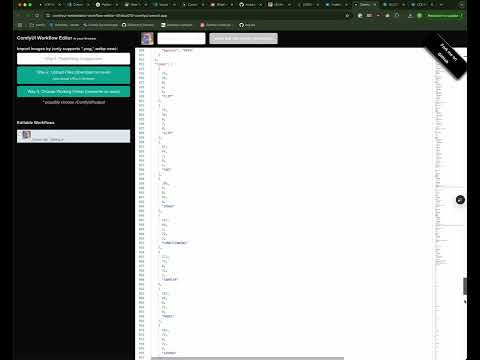
- Take your output from ComfyUI (PNG, WebP), and add the models urls to the workflow so a user will have them when they drag in the workflow. You can use this tool to edit the metadata of the PNG or WebP file.

-
Upload your workflow JSON and preview image to the example_workflows repository
-
Use the raw GitHub content URL in your documentation. To convert a GitHub file URL to a raw content URL:
- Start with your GitHub file URL:
https://github.com/Comfy-Org/example_workflows/blob/main/your-workflow.json - Change it to raw.githubusercontent.com and remove '/blob':
https://raw.githubusercontent.com/Comfy-Org/example_workflows/main/your-workflow.json
You can also click the "Raw" button on the GitHub file page and copy the URL directly.
- Start with your GitHub file URL:
This ensures the workflow metadata is preserved in the docs site when dragging it into ComfyUI.