

Run AI tasks on any hosted or local model, check answers against the sources that decide them, and keep a record of every step.
python -m pip install flywheel-verify
flywheel gate




Docs: https://harperz9.github.io/flywheel/docs/
Flywheel is a local harness for AI work.
- It puts any model, hosted or local, behind one OpenAI-compatible endpoint on your machine.
flywheel coderuns a coding agent in your terminal. By default it asks before it writes or runs anything.- Before an agent runs a shell command, a capability check reads the command and blocks network egress and other risky actions. The reason goes back to the model.
flywheel check-outputchecks the values in an answer against the source that decides them: a tax table, a formulary, a court calendar, a script you supply. It says which fields agree, which disagree and which nothing could confirm, and whether the answer may ship.- Every step lands on a hash-chained ledger. A sealed result can be checked again later, offline, with the Python standard library alone.
It also runs as a Windows desktop app with an assistant called Rowan, as a GitHub Action, and as an MCP host for a set of companion tools.
Python 3.11 or newer. The engine has no third-party runtime dependencies.
$ python -m pip install flywheel-verify
$ flywheel gate
  verify: verdict=PASS, output_hash=93e4b6c6b7a05c82, attribution=CANDIDATE
  seal: envelope_hash=1993af18b980c95d, claim_hash=23450831b0b42121, path=gate_envelope.json
  rewitness: result=MATCH
verdict=PASS rewitness=MATCH
flywheel gate runs a built-in task, checks the result, seals it into
artifacts/gate/gate_envelope.json and checks the seal again. It needs no
model and no network.
Check an answer against its source, using the Form 1040 example in examples/output-validation:
$ flywheel check-output --contract form-1040.contract.json --answer answer-as-filed.json --allow-commands
FAIL  1 of 2 fields confirmed
HOLD  blocked by: tax
  FAIL          tax: the value disagrees with irs-2025-tax-table-single
  PASS          taxable_income: the answer cites the return
The answer took its tax from the rate schedule. The form requires the tax table, so the check holds it. Exit codes: 0 confirmed, 1 disagrees, 3 unchecked.
Start a coding session in the current folder, or the local gateway and its
browser shell on http://127.0.0.1:8799:
$ flywheel code
$ flywheel up
flywheel code uses a local model server when one is running, or a provider
key you have set. flywheel doctor reports what is missing.
- LiteLLM and OpenRouter route requests to many models. Flywheel does too, and keeps a sealed record of each run on your machine.
- Claude Code, Aider and OpenHands are coding agents.
flywheel codeis one too, with a shell capability check before each command and a hash-chained ledger of every step. - Inspect AI, promptfoo and Guardrails AI score or validate model
output.
check-outputvalidates a value against a named authority and can emit the check as a Lean 4 file for a kernel to run.
Flywheel puts those pieces in one local tool. It has no evaluation task library of its own and no hosted gateway.
check-outputuses the authorities you supply. The finance, medicine and law packs ship field shapes and arithmetic, and no domain data.- The capability check uses a hand-curated map of executables. An executable it has never seen is admitted and recorded as unknown.
- Request content goes to the model provider you pick, under its terms. With a local model it stays on your machine.
- The desktop app ships for Windows only.
- In the Windows app's installed-app check, 15 of 17 lanes reach the class the check expects for them. index needs Git to reach it, and the pinned telos version has not been through that check yet (per-lane table).
pip install flywheel-verify
flywheel up
flywheel-verify is the PyPI name (the bare flywheel name is an unrelated
package). The installed command is flywheel.
One-line install into its own environment:
curl -fsSL https://raw.githubusercontent.com/HarperZ9/flywheel/main/install.sh | sh
on macOS and Linux, or
irm https://raw.githubusercontent.com/HarperZ9/flywheel/main/install.ps1 | iex
in PowerShell.
Homebrew (macOS, Linux) and Scoop (Windows), from the formula and manifest in this repository:
brew tap HarperZ9/flywheel https://github.com/HarperZ9/flywheel
brew install flywheel
scoop bucket add flywheel https://github.com/HarperZ9/flywheel
scoop install flywheel
Windows desktop app. Download the installer from the latest release and check it against the attached checksums. It bundles the engine and needs no Python. Its assistant, Rowan, turns a plain-words request into a task the app runs and records; see Meet Rowan.
Models. No model download is required. Point Flywheel at any hosted
provider you hold a key for; the roster shows whether a key is present and
never prints it. Ollama works over HTTP with no extras. The published
14B and
32B weights
are separate downloads, and the local serving and training stack installs with
pip install "flywheel-verify[local]". Receipt signing and egress monitoring
have their own extras ([signing], [monitor]).
Subscription sign-in. flywheel auth login <provider> runs a stepwise
flow (PKCE where the provider documents it, the provider's own tool where it
does not) and stores the token in the OS credential store, where the router
picks it up. See GETTING-STARTED.md.
From source:
git clone https://github.com/HarperZ9/flywheel.git
cd flywheel
pip install -e .
python scripts/run_harness_cli.py app --port 8799
Elsewhere. For the GitHub Action, see docs/GITHUB-ACTION.md. Inside another agent host, the Flywheel Evidence Task skill installs on its own, with Codex and Claude plugin manifests.

A task is routed to a model. When the model asks for a tool, the capability check allows or refuses the request. A refusal goes back to the model with its reason, and the model can try another route. The ledger keeps the request, the refusal and the reason alongside what ran.

The check reads a shell command the way a shell reads it, then names what the command can do. A denied word counts only in the executable position, so quoted text prints and a command substitution gets walked into. The map of names is curated by hand, and an executable it has never seen is admitted and recorded as unknown.
The animated explainer
steps through seven real commands, then seals and rechecks a result from
flywheel gate. Its source is docs/explainer/index.html.
flywheel check-output --contract task.contract.json --answer answer.json --allow-commands
Exit 0 confirmed, exit 1 disagrees, exit 3 unchecked. The report also says
whether the answer may ship: RELEASE, RELEASE_WITH_CAVEAT, or HOLD with
the fields that blocked it. Inside a lane, a held answer does not accept.
Finance, medicine and law each ship a pack of field templates for values that go wrong the same way: a dose the formulary bands, a deadline counted in calendar days where the rule counts court days, an amount carried to two decimals in a currency that has none.
flywheel packs medicine
The answer can arrive as a document, and the report can go out as one:
flywheel check-output --contract c.json --answer memo.md --report review.pdf
Markdown, LaTeX and PDF all carry an answer. The report is written as .txt,
.md, .tex, .pdf or .json, whichever the suffix names. The PDF comes out
byte-identical across runs.
--lean Answer.lean --verify-lean emits the check as a Lean 4 file and runs
the kernel on it. What the kernel settles becomes a theorem, what an outside
authority decided becomes a named axiom, and #print axioms lists what the
result depends on. A kernel refusal shows up in the exit code.
See docs/OUTPUT-VALIDATION.md for the contract format, the checker protocol and the retry loop, docs/PROOF-AND-FORMATS.md for document formats and the Lean output, and docs/CRITICAL-DOMAINS.md for the packs.
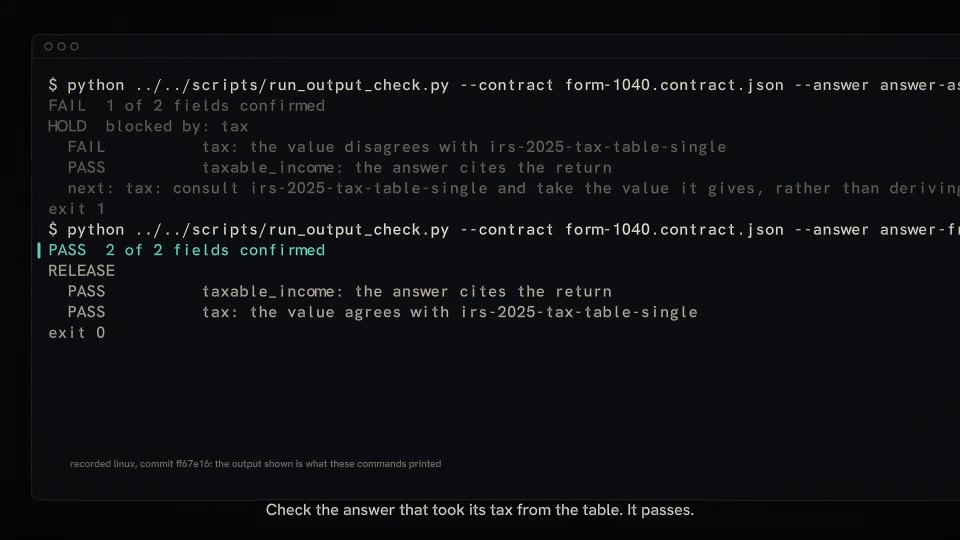
Flywheel: check an answer against its source (28 s).
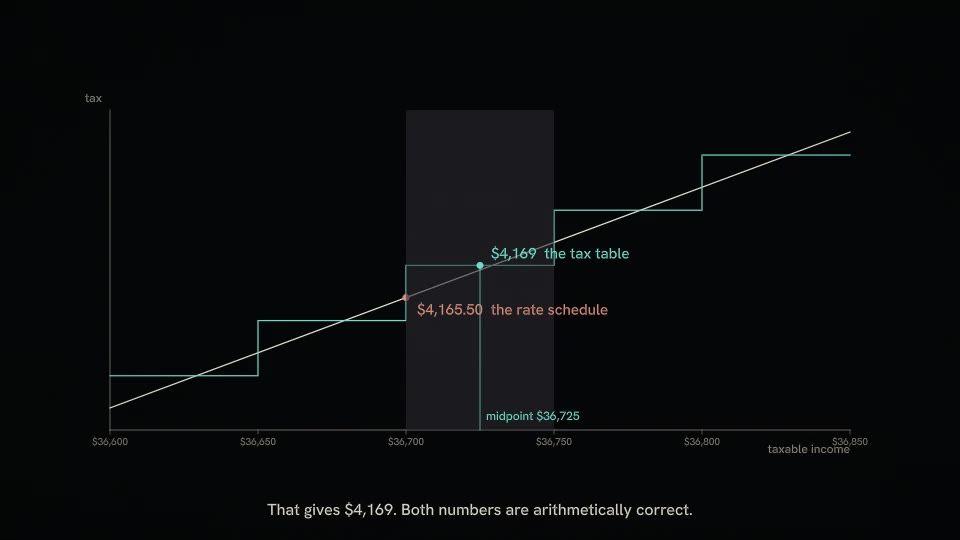
Which source decides (55 s).
Video files: check an answer against its source and which source decides, captioned and attached to each release.
7 suites run with no model endpoint and no network, so you get these numbers back on your own machine:
python scripts/run_offline_benchmarks.py| suite | what it answers | headline |
|---|---|---|
| accountability | does an unaccountable system score badly here | dimensions 8; harness_overall 1.0; separation 0.99; strawman_overall 0.01 |
| governed-agent | does a workflow refuse an action above its tier | failed 0; mean_quality_score 0.542; pass_rate 1.0; passed 6; scenarios 6 |
| agent-recovery | does an injected fault recover without failing quietly | receipt_completeness 1.0; recovery_success_rate 1.0; scenarios 6; silent_failure_rate 0.0 |
| stateful-provider-swap | does state survive a provider swap | checks 10; pass_rate 1.0; passed True |
| source-mined | do the mined checks still hold against their datasets | cases 26; failed 0; metrics_asserted 170; pass_rate 1.0; passed 26 |
| paired-replication | did continued pretraining change general code completion | delta_points -0.0305; gains 9; p_exact 0.4049; regressions 14; tasks 164 |
| receipting-cost | what does it cost to keep the receipt | durability_share 0.8742; log_bytes_per_action 788.3; ms_per_witnessed_action 8.79; recheck_us_per_record 21.5; verdict MATCH |
The strawman, a system with no receipts, scores 1% on the same axes. A benchmark that everything passes measures nothing.
Against 5 named peers (codex, cursor, claude code, hermes, omp): 48 capabilities, 48 witnessed in this repository by a check that runs every time the matrix is read, and 10 that every peer was read on and none declares. 9 rows carry at least one peer surface nobody here has read, and a star is withheld from every one of them, so the starred count moves up as the reading is done and not before. The peer columns are dated readings of public documentation and public source, not measurements taken here.
Full results, the matrix, and the measurements that were not taken: docs/BENCHMARKS.md.
One of those suites recomputes the project's only capability comparison, and it is negative: continued pretraining on the workspace corpus moved general code completion -3.05 percentage points over 164 tasks, p = 0.40. It is here because a negative result published is worth more than a positive one withheld.
The arms benchmark is a separate instrument, retired on 2026-07-26. The arms were not independent: the treatment's first attempt is the same call as the baseline's only attempt, so the treatment cannot score lower and the difference is not a comparison. The quantity measured is verified pass@k. The retired table read verified inference 9/10 against single-shot 8/10, difference +0.100 with 95% CI [-0.236, +0.420], an interval that includes zero, and no capability uplift is claimed.

harness/is the Python engine. It runs tasks, checks tool requests, writes run records, discovers companion tools, and serves the localhost API. The installed runtime uses only the Python standard library.desktop/is the Flutter client. It talks to the gateway over localhost and can launch the bundled engine on Windows without a separate Python install. Its assistant, Rowan, runs on the model you choose.site/is the browser fallback used in development and CI.
Run the native client from a checkout:
cd desktop
flutter run -d windows --release
From a checkout, python -m harness.cli_entry app --port 8799 also serves the
browser fallback at /site/index.html. The desktop app serves its UI on
localhost only and contacts no external address to show it.
Flywheel can connect to fourteen companion tools. Each has a public repository:
| Tool | Repository | What it does |
|---|---|---|
| gather | gather | Collect research and record its sources. |
| crucible | crucible | Recheck a claim and report a match, change, or missing evidence. |
| index | index | Map files and symbols in a workspace. |
| forum | forum | Route work among models and record decisions. |
| learn | learn | Turn your material and recorded attempts into a study plan. |
| telos | telos | Reconcile findings from several tools. |
| local-model | archived predecessor | Historical engine repository. Its runtime is now part of Flywheel; the lane name remains for compatibility. |
| relay | relay | Run a coding agent with a local or hosted model. |
| plexus | plexus | Find installed tools and connect them. |
| mneme | mneme | Store and retrieve memories with source checks. |
| calibrate-pro | calibrate-pro | Check display calibration targets and readiness. |
| accountable-surface | accountable-surface | Require approval before actions and keep a tamper-evident record. |
| canon | canon | Keep one set of instructions and memories across the assistants you use, and see what each one would be given. |
| bulletin | bulletin | Reach an open message board where agents post, search, and reply under a signed identity. Watch it live. |
List their configured state, or probe their live MCP connections:
flywheel lanes
flywheel lanes --probe    # live MCP handshake per lane
The bulletin board is live at https://harperz9.github.io/bulletin.html and
needs no key or account to read. Flywheel contacts no board until you choose
one: set FLYWHEEL_BULLETIN_URL to the board's MCP URL to use the Bulletin
lane, and FLYWHEEL_BULLETIN_BASE_URL to its HTTPS origin to register an
identity. Anyone can post there, so treat what you read as untrusted input.

Routed runs keep a ledger of tool names, arguments and outputs. With sealed
tool-call receipts turned on, each call also records its capability
(builtin-read, builtin-write, builtin-exec, external-mcp or unknown),
its outcome, hashes of its arguments and output, and the hash of the previous
receipt. If one receipt in the chain is invalid, the entries after it read as
unverifiable.
- Signed citations.
harness/grounding_signatures.pyreads an Ed25519 sidecar beside a receipt and reports it absent, invalid or valid. An unsigned store behaves as before. - Scheduled runs. A schedule runs when something asks for a tick; there is
no daemon. Each schedule names its catch-up policy: fire every missed
occurrence, fire the most recent one, or drop them. A schedule stops itself
after two failed fires in a row, including a hook that exits 0 while its
output ends on a rate-limit or quota error, and stays stopped until you press
Re-arm on its row (
docs/RUN-BUDGET.md). - Code scan coverage. Beside the finding count, a scan records how many files it read out of how many exist, whether the ruleset still fires, and how many findings were suppressed.
- Every route in the app. A coverage check fails when a route the gateway serves has no way in from the desktop client. It reads 152 of 152 today.
- Lessons from failures. A proposed lesson carries hashes of its evidence and stays a proposal until a person accepts it. See docs/LESSON-LOOP.md.
- QUICKSTART.md: first ten minutes
- GETTING-STARTED.md: install, sign in, first run
- WALKTHROUGH.md: guided tour
- docs/FLYWHEEL-1.0.0-OVERVIEW.md: the full feature set and an install-to-first-verdict walkthrough
- docs/features/: per-feature docs and how the lanes fit together
- docs/CONFIGURATION.md: settings
- docs/OUTPUT-VALIDATION.md: check an answer against the source that decides it
- docs/PROOF-AND-FORMATS.md: Markdown, LaTeX and PDF in and out, and the Lean output
- docs/CRITICAL-DOMAINS.md: the finance, medicine and law packs
- docs/TRACE-OWNERSHIP.md: where agent traces live, and status, encryption, export, deletion, import and retention
- docs/trace-redaction.md: what trace redaction catches and misses
- docs/WRAPPER-HOOKS.md: capture hooks for Claude Code and Codex
- docs/CONTEXT-MEMORY.md: context and memory binding per owner and project
- docs/native-cli-session-contract.md: native CLI session profiles
- docs/native-continuation.md: continuation preview
- docs/writing-workspace.md: the Writing Workspace and its MCP launcher
- docs/REMOTE-ACCESS.md: drive the same loop from your phone
- docs/LESSON-LOOP.md and docs/GUIDE-LESSON-LOOP.md: the lesson loop, architecture and full guide
- docs/BENCHMARKS.md: full benchmark results and the peer matrix
- docs/INSPECT-EVIDENCE.md: Inspect JSON import (development)
- docs/INCIDENT-SIM-EVALUATION.md: incident traces and process-audit packets (development)
- docs/CLIENT-AND-TOOL-ARCHITECTURE.md: the desktop client, the engine and the companion tools
- desktop/README.md: desktop development and packaging
Zain Dana Harper maintains this repository. AI-assisted tools are used for parts of development and documentation.
Text: CC BY 4.0. Code: FSL-1.1-MIT.
The essays in docs/essays/ and the research notes in
docs/research/, project-docs/research/ and tasks/research/ are licensed
CC BY 4.0. Share and adapt them with credit to Zain Dana Harper; the terms are
in LICENSE-TEXT. The code and the software documentation are
FSL-1.1-MIT (Functional Source License). See LICENSE.